Review Cape Cod Times Crazy for You College Light Opera Company
| Flight Dutchman | |
|---|---|
 The Flying Dutchman by Albert Pinkham Ryder c. 1887 (Smithsonian American Art Museum) | |
| Helm | Willem van der Decken |
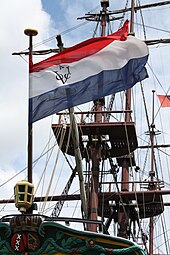
The Flying Dutchman (Dutch: De Vliegende Hollander) is a legendary ghost transport which was said to never be able to make port, doomed to sheet the oceans forever. The myth is likely to accept originated from the 17th-century Golden Age of the Dutch Due east India Company (VOC)[i] [2] [3] [4] and Dutch maritime power.[5] [6] [7] The oldest extant version of the legend has been dated to the late 18th century. Co-ordinate to the legend, if hailed by another transport, the coiffure of the Flying Dutchman was said to try to send messages to land, or to people long dead. Reported sightings in the 19th and 20th centuries claimed that the transport glowed with a ghostly light. In ocean lore, the sight of this phantom ship is a portent of doom.
Origins [edit]


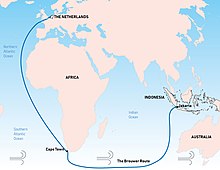
The first print reference to the ship appears in Travels in various function of Europe, Asia and Africa during a serial of thirty years and upwardly (1790) past John MacDonald:
The atmospheric condition was so stormy that the sailors said they saw the Flying Dutchman. The common story is that this Dutchman came to the Cape in distress of weather and wanted to go into harbour but could not get a airplane pilot to conduct her and was lost and that always since in very bad weather her vision appears.[11]
The adjacent literary reference appears in Chapter Half-dozen of A Voyage to Botany Bay (1795) (also known as A Voyage to New Due south Wales), attributed to George Barrington (1755–1804):[nb 1]
I had frequently heard of the superstition of sailors respecting apparitions and doom, but had never given much credit to the report; it seems that some years since a Dutch man-of-war was lost off the Cape of Practiced Hope, and every soul on board perished; her consort weathered the gale, and arrived shortly after at the Cape. Having refitted, and returning to Europe, they were assailed by a violent tempest well-nigh in the same latitude. In the nighttime picket some of the people saw, or imagined they saw, a vessel continuing for them under a press of sail, as though she would run them downward: i in item affirmed it was the ship that had foundered in the sometime gale, and that information technology must certainly be her, or the apparition of her; but on its clearing up, the object, a dark thick cloud, disappeared. Nothing could practice away the thought of this phenomenon on the minds of the sailors; and, on their relating the circumstances when they arrived in port, the story spread similar wild-burn, and the supposed phantom was called the Flying Dutchman. From the Dutch the English seamen got the infatuation, and there are very few Indiamen, but what has some 1 on lath, who pretends to have seen the apparition.[12]
The adjacent literary reference introduces the motif of punishment for a criminal offense, in Scenes of Infancy (Edinburgh, 1803) by John Leyden (1775–1811):
It is a common superstition of mariners, that, in the high southern latitudes on the coast of Africa, hurricanes are oft ushered in by the advent of a spectre-ship, denominated the Flying Dutchman ... The coiffure of this vessel are supposed to take been guilty of some dreadful crime, in the infancy of navigation; and to accept been stricken with pestilence ... and are ordained still to traverse the bounding main on which they perished, till the period of their penance expire.[nb 2]
Thomas Moore (1779–1852) places the vessel in the north Atlantic in his poem Written on passing Dead-man's Island in the Gulf of St. Lawrence, Belatedly in the evening, September, 1804:[xiii] "Fast gliding along, a gloomy bark / Her sails are full, though the wind is still, / And there blows not a breath her sails to fill." A footnote adds: "The above lines were suggested past a superstition very mutual among sailors, who call this ghost-ship, I think, 'the flying Dutch-man'."
Sir Walter Scott (1771–1832), a friend of John Leyden'due south, was the start to refer to the vessel as a pirate send, writing in the notes to Rokeby; a poem (start published December 1812) that the ship was "originally a vessel loaded with neat wealth, on board of which some horrid act of murder and piracy had been committed" and that the apparition of the ship "is considered by the mariners as the worst of all possible omens".
According to some sources, 17th-century Dutch captain Bernard Fokke is the model for the captain of the ghost ship.[14] Fokke was renowned for the speed of his trips from the Netherlands to Java and was suspected of being in league with the Devil. The outset version of the legend as a story was printed in Blackwood's Edinburgh Magazine for May 1821,[15] which puts the scene every bit the Cape of Good Promise. This story introduces the proper name Captain Hendrick Van der Decken for the captain and the motifs (elaborated by later writers) of letters addressed to people long dead being offered to other ships for delivery, but if accustomed will bring misfortune; and the helm having sworn to circular the Greatcoat of Good Hope though it should take until the day of judgment.
She was an Amsterdam vessel and sailed from port seventy years agone. Her master's name was Van der Decken. He was a staunch seaman, and would have his ain manner in spite of the devil. For all that, never a sailor under him had reason to complain; though how it is on lath with them nobody knows. The story is this: that in doubling the Cape they were a long day trying to conditions the Table Bay. All the same, the wind headed them, and went against them more and more, and Van der Decken walked the deck, swearing at the current of air. Only after sunset a vessel spoke him, asking him if he did not mean to go into the bay that night. Van der Decken replied: "May I be eternally damned if I do, though I should beat nearly hither till the 24-hour interval of judgment." And to be sure, he never did go into that bay, for it is believed that he continues to vanquish about in these seas still, and will do and then long enough. This vessel is never seen but with foul weather along with her.[16]
Reported sightings [edit]
There accept been many reported or alleged sightings in the 19th and 20th centuries. A well-known sighting was past Prince George of Wales, the future King George V. He was on a three-yr voyage during his late adolescence in 1880 with his elder brother Prince Albert Victor of Wales and their tutor John Neill Dalton. They temporarily shipped into HMSInconstant after the damaged rudder was repaired in their original ship, the iv,000-tonne corvette Bacchante. The princes' log (indeterminate every bit to which prince, due to subsequently editing before publication) records the following for the pre-dawn hours of 11 July 1881, off the declension of Australia in the Bass Strait between Melbourne and Sydney:
July 11th. At 4 a.thou. the Flying Dutchman crossed our bows. A foreign reddish lite as of a phantom send all aglow, in the midst of which light the masts, spars and sails of a brig 200 yards distant stood out in strong relief as she came upward on the port bow, where also the officer of the watch from the bridge conspicuously saw her, as did the quarterdeck midshipman, who was sent forrad at in one case to the forecastle; simply on arriving there was no vestige nor any sign any of whatever material ship was to be seen either near or right away to the horizon, the night beingness clear and the ocean at-home. Xiii persons altogether saw her ... At ten.45 a.m. the ordinary seaman who had this morning reported the Flight Dutchman fell from the foretopmast crosstrees on to the topgallant forecastle and was smashed to atoms.[17]
Nicholas Monsarrat, the novelist who wrote The Cruel Ocean, described the phenomenon in the Pacific Sea in his unfinished concluding book "Master Mariner", which was partly inspired by this tale (he lived and worked in South Africa after the war) and the story of the Wandering Jew.
Explanations every bit an optical illusion [edit]
Probably the nearly apparent explanation is a superior mirage or Fata Morgana seen at ocean.

The news soon spread through the vessel that a phantom-transport with a ghostly crew was sailing in the air over a phantom-ocean, and that information technology was a bad omen, and meant that non one of them should e'er meet land again. The captain was told the wonderful tale, and coming on deck, he explained to the sailors that this strange appearance was caused by the reflection of some ship that was sailing on the water below this image, just at such a distance they could not run into it. There were certain conditions of the atmosphere, he said, when the sun'southward rays could grade a perfect moving-picture show in the air of objects on the earth, like the images one sees in drinking glass or water, but they were not generally upright, as in the example of this transport, simply reversed—turned lesser upwards. This appearance in the air is called a mirage. He told a sailor to get upwardly to the foretop and expect beyond the phantom-send. The human being obeyed, and reported that he could run across on the h2o, below the ship in the air, one precisely like it. Just then another ship was seen in the air, only this one was a steamship, and was bottom-upwards, equally the captain had said these mirages mostly appeared. Soon after, the steamship itself came in sight. The sailors were at present convinced, and never afterwards believed in phantom-ships.[18]
Another optical upshot known as looming occurs when rays of calorie-free are bent across different refractive indices. This could make a ship simply off the horizon appear hoisted in the air.[xix]
Adaptations [edit]
There is a 20-foot 1-design high-performance two-person monohull racing dinghy named the Flying Dutchman (FD). It made its Olympic debut at the 1960 Summer Games competitions in the Gulf of Naples and is yet one of the fastest racing dinghies in the world.[20]
In artworks and pattern [edit]
The Flying Dutchman has been captured in paintings past Albert Ryder, at present in the Smithsonian American Art Museum, Washington, D.C., and by Howard Pyle, whose painting of the Flying Dutchman is on exhibit at the Delaware Fine art Museum.
In goggle box series and comics [edit]
- Efteling Productions made a short picture to innovate the backstory of the Flying Dutchman and Captain 'Willem van der Decken'.
- Efteling Productions made in 2010 a documentary virtually the construction of the allure 'The Flight Dutchman'.
- Scooby-Doo featured a Flight Dutchman ghost modeled after the illustrator Howard Pyle'south 1900 delineation of the character
- "The Flying Dutchman" is both the name of a pirate ghost (a flying Dutchman) and his haunted pirate ship (The Flying Dutchman) in the Nickelodeon animated one-act series SpongeBob SquarePants. The onetime is voiced by Brian Doyle-Murray, and the latter is based on Queen Anne's Revenge.
- Carl Barks wrote and drew a 1959 comic volume story where Uncle Scrooge, Donald Duck and Huey, Dewey, and Louie meet the Flying Dutchman.[21] Barks ultimately explains the "flight" send equally an optical illusion.
- In Eiichiro Oda'southward manga One Piece as well equally the anime television series, Fishman Vander Decken Nine (バンダー・デッケン九世, Bandā Dekken Kyūsei), a descendant of the original Helm Van der Decken, is the Flying Dutchman 's current captain who appears equally a major villain in the "Fishman Island" arc. He is an inversion of the normal legend, being a fish-man who has been cursed to never again be able to swim, as opposed to a human who can never set foot on land.[22]
- In Soul Eater, the Flying Dutchman is the soul of the ghost ship.
- In the 1967 Spider-Man cartoon episode "Return of the Flying Dutchman" the fable of the Flying Dutchman is used past Spider-Man'southward enemy Mysterio to frighten villagers and plunder their wealth.
- In 1967, the Flying Dutchman was featured in the Voyage to the Bottom of the Sea episode "Cavern of the Expressionless".
- In a 1959 episode of Rod Serlings Judgment Dark (The Twilight Zone) a cruel and merciless U-Helm that sank an Allied passenger ship in Earth State of war Ii finds himself doomed to forever relive the experience as a "Flight Dutchman" passenger of the torpedoed ship
- An episode chosen "The Inflow" (1961, written by Rod Serling) of the television series The Twilight Zone depicts an airplane that arrives at a busy airdrome. The airplane is discovered to take no crew, passengers, or luggage. At the tail end of the prior episode ("Two"), Rod Serling advertises "The Arrival" as a retelling of the Flying Dutchman tale. It also gets a mention in the endmost narration of the episode "Death Ship".
- An episode called "Lone Survivor" (1971, written past Rod Serling) of the television series Night Gallery has the story of a Flying Dutchman survivor of the RMS Titanic who because of his cowardice is forever doomed to exist picked up by ships that will sink...kickoff the RMS Lusitania in 1915 and and then past the SS Andrea Doria in 1956.
- In a 1976 episode of Land of the Lost, the Marshalls discover the captain of a mysterious ship that appears in "the mist". Later on in the episode, it is discovered that the ship is the Flight Dutchman.
- In the 1982 Fantasy Island episode "A Very Strange Affair; The Sailor", Peter Graves plays a portrayal of the Flying Dutchman in the hopes of breaking his curse by meeting someone who is willing to dice for him.
- In 2001, Andromeda aired a showtime-flavour episode "The Mathematics of Tears", in which the Flying Dutchman figured explicitly in the plot.
- In an episode of Supernatural a ghost ship heralds the death of the victims of a first mate'southward ghost. The ship is compared to the Flying Dutchman by Sam Winchester.
- In the upcoming Halloween special of Santiago of the Seas, a Ghost Helm tin can scare Santiago and his crew, voiced by Mark Hamill.
In film [edit]
The story was dramatised in the 1951 motion-picture show Pandora and the Flying Dutchman, starring James Stonemason (who plays the Dutch Captain Hendrick Van der Decken) and Ava Gardner (who plays Pandora). In this version, the Flight Dutchman is a man, not a ship. The two-hour long film, scripted by its director Albert Lewin, sets the main activeness on the Mediterranean coast of Spain during the summertime of 1930. Centuries earlier the Dutchman had killed his wife, wrongly assertive her to be unfaithful. At his trial he is unrepentant and curses God. Providence condemned him to roam the seas until he found the true pregnant of dear. In the only plot device taken from earlier versions of the story, once every seven years the Dutchman is allowed ashore for six months to search for a woman who volition love him plenty to dice for him, releasing him from his expletive, and he finds her in Pandora.

In the Pirates of the Caribbean films, the transport made its outset appearance in Dead Homo'south Chest (2006) under the command of the fictional captain, Davy Jones. The story and attributes of the send were inspired by the actual Flying Dutchman of nautical lore.
In literature [edit]
The 1797–98 poem by Samuel Taylor Coleridge, The Rime of the Ancient Mariner, contains a like account of a ghost send, which may take been influenced by the tale of the Flight Dutchman.[23] [24] One of the first Flying Dutchman short stories was titled "Vanderdecken'southward Bulletin Domicile; or, the Tenacity of Natural Affection" and was published in Blackwood's during 1821.[25]
Dutch poet J. Slauerhoff published a number of related poems, especially in his 1928 volume Eldorado.[26] [27]
This story was adjusted in the English language melodrama The Flying Dutchman; or the Phantom Send: a Nautical Drama, in iii acts (1826)[nb 3] by Edward Fitzball (1792–1873), music by George Rodwell,[28] and the novel The Phantom Transport (1839)[nb 4] past Frederick Marryat. This in plough was later adjusted every bit Het Vliegend Schip (The Flight Send) by the Dutch chaplain, A. H. C. Römer. In Marryat's version, Terneuzen, in kingdom of the netherlands, is described as the home of the captain, who is called "Van der Decken" ("of the decks").
Another accommodation was The Flight Dutchman on Tappan Ocean by Washington Irving (1855), in which the captain is named Ramhout van Dam. Irving had already used the story (based on Moore'south poem) in his Bracebridge Hall (1822). Hedvig Ekdal describes visions of the Flying Dutchman from the books she reads in the attic in Henrik Ibsen's The Wild Duck (1884).
John Boyle O'Reilly's The Flying Dutchman was first published in The Wild Goose, a handwritten newspaper produced past Fenian convicts being transported to Western Australia in 1867.[29]
The Death Ship, past Due west. Clark Russell, was published in 1888. Information technology is narrated by Geoffrey Fenton, descendant of Edward Fenton, second mate of the English ship Saracen on a voyage to the Eastward Indies in 1796. Fenton's ship encounters the Flight Dutchman, and an accident leaves him stranded aboard the cursed transport with her ghostly crew. The captain, Cornelius Vanderdecken, tells Fenton that his transport, the Braave, sailed from Batavia in 1653.
I looked at him every bit closely as I durst. His eyes were extraordinarily piercing and passionate, with the cruel brilliance in them such every bit may be noticed in the insane; the lower part of his face up was hidden in pilus, simply the skin of as much of it as was visible, for his cap was dragged low down upon his brows, was pale, of a haggard sallowness, expressed best in paintings of the dead where time has produced the original whiteness of the paint. It was impossible that I should accept observed this in him in the mani-coloured lamplight of the preceding night. Yet did non his graveyard complexion backbite from the majesty and imperiousness of his mien and port. I could readily conceive that the defiance of his centre would be hell-like in obstinacy, and that here was a man whose pride and passions would qualify him for a foremost place among the most daring of those fallen spirits of whom our glorious poet has written.
British author Brian Jacques wrote a trilogy of fantasy/immature adult novels concerning 2 reluctant members of the Dutchman 's crew, a young boy and his dog, who were swept off the ship by a wave on the dark the ship was cursed; withal, the same angel who pronounced the curse on the send and crew appeared to them and blessed them, charging them to help those in demand . The outset novel was titled Castaways of the Flying Dutchman and was get-go published by Puffin Books in 2001. The second was titled The Angel's Command and was released by Puffin in 2003. The third and final book of the trilogy (due to Jacques' death in 2011) was titled Voyage of Slaves and was released by Puffin in 2006.
In the novel The Flying Dutchman (2013) past the Russian novelist Anatoly Kudryavitsky, the ghost send rebuilds itself from an erstwhile clomp abandoned on the banking concern of a large Russian river, and offers itself as a refuge to a persecuted musicologist.
The comic fantasy Flying Dutch past Tom Holt is a version of the Flying Dutchman story. In this version, the Dutchman is not a ghost transport but crewed by immortals who can just visit land one time every seven years when the unbearable smell that is a side-effect of the elixir of life wears off.
The Roger Zelazny curt story "And But I Am Escaped to Tell Thee" tells of a sailor who escapes from the Flying Dutchman and is rescued by sailors who welcome him to the Mary Celeste.
Ward Moore in his 1951 story "Flying Dutchman"[30] used the myth as a metaphor for an automated bomber plane which continues to fly over an Earth where humanity long since totally destroyed itself and all life in a nuclear state of war.
In the Expeditionary Force series by Craig Alanson, the Flying Dutchman is a large alien starship that has been commandeered by the human protagonist Joe Bishop, an aboriginal AI named Skippy and a multi-national armed services and civilian crew - who named the send.
In the sci-fi novel series The Expanse by James S.A. Corey, a mysterious conflicting presence causes unabridged ships to disappear when passing through transdimensional gateways. Until humanity came to understand the exact nature of the phenomenon, ships lost in this way were described equally "going Dutchman".
In opera and theatre [edit]

Richard Wagner'southward opera The Flight Dutchman (1843) is adapted from an episode in Heinrich Heine'southward satirical novel The Memoirs of Mister von Schnabelewopski (Aus den Memoiren des Herrn von Schnabelewopski) (1833), in which a character attends a theatrical operation of The Flight Dutchman in Amsterdam. Heine had first briefly used the legend in his Reisebilder: Die Nordsee (Pictures of Travel: the Due north Bounding main) (1826), which simply repeats from Blackwood's Magazine the features of the vessel being seen in a tempest and sending messages addressed to persons long since dead. In his 1833 elaboration, it was once thought that it may have been based on Fitzball'southward play, which was playing at the Adelphi Theatre in London, only the run had concluded on seven April 1827 and Heine did not go far in London until the 14th.[nb v] Heine was the beginning author to innovate the chance of salvation through a woman's devotion and the opportunity to gear up pes on land every seven years to seek a faithful wife. This imaginary play, unlike Fitzball's play, which has the Cape of Practiced Hope location, in Heine's account is transferred to the North Sea off Scotland. Wagner'south opera was similarly planned to accept place off the coast of Scotland, although during the terminal rehearsals he transferred the action to some other function of the North Sea, off Norway.
Pierre-Louis Dietsch equanimous an opera Le vaisseau fantôme, ou Le maudit des mers ("The Phantom Ship, or The Accursed of the Sea"), which was commencement performed on nine November 1842 at the Paris Opera. The libretto by Paul Foucher and H. Révoil was based on Walter Scott's The Pirate as well every bit Captain Marryat's The Phantom Send and other sources, although Wagner thought it was based on the scenario of his own opera, which he had merely sold to the Opera. The similarity of Dietsch's opera to Wagner'due south is slight, although Wagner'south assertion is often repeated. Berlioz idea Le vaisseau fantôme too solemn, just other reviewers were more favourable.[31] [32]
Dutchman (play), a short play past Amiri Baraka, was kickoff performed in 1964.
In music [edit]
- In 1949 RCA Victor, inventors of the single 45 RPM format, released as ane of their first 45s a recording of the fable in song in bandleader Hugo Winterhalter'due south "The Flying Dutchman", sung every bit a sea shanty.
- Jethro Tull refer to the Flying Dutchman with a song of the same name from their 1979 album Stormwatch.
- Tori Amos refers to the Flying Dutchman in her 1992 single B side "Flying Dutchman", the A side beingness "Mainland china". It was re-released in 2012 on her album Gold Dust and performed on The Gilt Dust Orchestral Tour.
- Jimmy Buffett refers to the Flying Dutchman in his 1995 song "Remittance Man" on the anthology Barometer Soup.
- Rufus Wainwright refers to the Flying Dutchman in his vocal "Flying Dutchman" on the album Poses.
- Dutch symphonic black metal band Carach Angren wrote a concept anthology near the Flying Dutchman entitled Death Came Through a Phantom Ship.
- God Dethroned, a Dutch expiry metallic band, featured the song "Soul Capture 1562" near the Flight Dutchman on their album Bloody Blasphemy.
In radio drama [edit]
The tale was the subject of the radio drama The Witch's Tale broadcast on i February 1932.
The story was adapted by Judith French into a play, The Dutch Mariner, circulate on BBC Radio 4 on 13 April 2003.[33]
In video games [edit]
In the 1993 multiplatform game Alone in the Dark two, fictional detective Edward Carnby investigates a missing girl who he discovers has been kidnapped by the undead One-Eyed Jack who, in the game, is helm of the undead crew of The Flight Dutchman.
In 1997, the Flying Dutchman was included equally a crook unit of measurement in Microsoft's Age of Empires
The Flying Dutchman is depicted in Terraria every bit a flying wooden transport with four destructible, broadside cannons. It appears within the Pirate Invasion as a boss enemy.
In 2017, the online FPS game Paladins added a Flight Dutchman skin for its Makoa character.[34]
In 2020, the online FPS game Overwatch added a Flying Dutchman skin for its Dutch character, Sigma.
In leisure [edit]
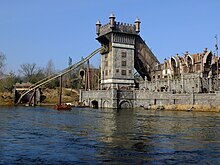
Flying Dutchman rollercoaster at Efteling amusement park
The Efteling amusement park in the Netherlands has a roller coaster chosen The Flying Dutchman which features the captain named Willem van der Decken (nl).
Worlds of Fun amusement park in Kansas City, Missouri has a swinging boat ride chosen The Flight Dutchman.
6 Flags over Georgia, an amusement park located in Austell, Georgia also had a swinging boat ride called The Flying Dutchman which was added in 1980.
In aviation [edit]

The Dutch aviation pioneer and an shipping manufacturer Anthony Fokker was nicknamed The Flying Dutchman.[35]
KLM Regal Dutch Airlines references the endless traveling aspect of the story by having The Flying Dutchman painted on the rear sides of all its shipping with regular livery.
In education [edit]
The nickname of Lebanon Valley Higher is "The Flying Dutchmen", and its mascot "The Flying Dutchman". The nickname references the higher'due south location in the Pennsylvania Dutch Land.
Hofstra Academy on Long Island, New York was unofficially named "The Flying Dutchman" and has many references to Dutch culture around the university including residence halls. The official team proper name was inverse to "The Pride" in 2004, referring to a pair of lions which became the school's athletic mascots in the late 1980s.
Hope College in Kingdom of the netherlands, Michigan is besides the home of "The Flight Dutchman" considering information technology was founded by settlers from the Netherlands in 1866.
In Sailing [edit]
Flying Dutchman Dinghy
In sports [edit]
Baseball game [edit]
Honus Wagner was nicknamed "The Flying Dutchman" due to his superb speed and German heritage.
Auto racing [edit]
Dutch commuter Arie Luyendyk, two-time champion of the Indianapolis 500 and withal record-holder for the quickest time ever run to qualify for the race in 1996, was nicknamed the Flying Dutchman past fans and media.
Football [edit]
Dutch football game player Dennis Bergkamp was nicknamed "the Non-Flight Dutchman", because of his fearfulness of flying.
Dutch football game player Robin Van Persie was nicknamed "the Flying Dutchman", because of his infamous headed goal against Spain in the 2014 FIFA World Cup grouping lucifer.
Come across also [edit]
- 90377 Sedna – nicknamed the Flight Dutchman
- Caleuche
- Chasse-galerie
- Peter Rugg
- Wandering Jew
- Wild Hunt
- List of ghosts
Notes [edit]
- ^ George Barrington (originally Waldron) was tried at the Sometime Bailey in London in September 1790 for picking pockets and sentenced to transportation for seven years. He embarked on the convict send Active which sailed from Portsmouth on 27 March 1791 and arrived at Port Jackson (Sydney), just to the north of Botany Bay, on 26 September, having anchored briefly at Table Bay in very tardily June. The various accounts of his voyage and activities in New S Wales announced to be literary forgeries by publishers capitalizing both on his notoriety and in public interest for the new colony, combining turns of phrase from his trial speeches with plagiarized genuine accounts of other writers apropos Botany Bay. Run into George Barrington's Voyage to Botany Bay edited past Suzanne Rickard (Leicester Academy Printing, 2001). A Voyage to Botany Bay and A Voyage to New S Wales, both issued in 1795, were revamped versions of An Impartial and Circumstantial Narrative of the Present State of Botany Bay, which had appeared in 1793–94, but which did not include the Flight Dutchman reference.
- ^ Leyden says that Chaucer, echoing Dante's account of the Second Circumvolve of Hell in his Inferno, alludes to a penalization of a similar kind in his poem The Parlement of Foules: "And breakers of the laws, sooth to sain, / And carnal folk, subsequently that they been expressionless, / Shall whirl nigh the earth alway in pain, / Till many a world be passed out of dread."
- ^ The 48-page text published c. 1829 acknowledges Blackwood's 1821 story as the source, although the 2 have piffling in common.
- ^ Originally published in instalments in the New Monthly Magazine (London) March–October 1837, January–Feb 1838 & February–August 1839 earlier appearing in book form in 1839. Marryat's gripping story added no new elements to the legend.
- ^ The play was not published until its revival in 1829. On all these points come across Musical Times (London), March 1986, p. 133.
References [edit]
- ^ Beck, Timothy: Vermeer'due south Hat: The Seventeenth Century and the Dawn of the Global World. (Bloomsbury Press, 2008, pp. 288, ISBN 978-1596915992)
- ^ Sayle, Murray (five Apr 2001). "Nihon goes Dutch". London Review of Books. Vol. 23, no. seven.
Holland United Eastward Indies Visitor (Verenigde Oostindische Compagnie, or VOC), founded in 1602, was the world'south first multinational, articulation-stock, express liability corporation – as well equally its commencement government-backed trading cartel. Our ain East India Visitor, founded in 1600, remained a coffee-house clique until 1657, when it, too, began selling shares, non in individual voyages, but in the Company itself, by which time its Dutch rival was past far the biggest commercial enterprise the world had known.
- ^ Hagel, John; Brown, John Seely (12 March 2013). "Institutional Innovation: Creating Smarter Organizations". Deloitte Insights.
[...] In 1602, the Dutch East India Company was formed. It was a new type of institution: the get-go multinational company, and the offset to outcome public stock. These innovations allowed a single company to mobilize fiscal resources from a large number of investors and create ventures at a scale that had previously only been possible for monarchs.
- ^ Taylor, Bryan (6 November 2013). "The Rise and Autumn of the Largest Corporation in History". BusinessInsider.com. Retrieved 8 August 2017.
- ^ Glete, Jan (2001), 'The Dutch Navy, Dutch State Formation and the Rise of Dutch Maritime Supremacy'. (Paper for the Anglo-American Conference for Historians: The Sea, 4–6 July 2001, University of London, Institute of Historical Research). In Swedish historian Jan Glete's words, "From the tardily sixteenth to the early eighteenth century... Dutch maritime activities are normally described every bit superior to those of other nations and proofs of the Dutch order's ability to combine engineering science, entrepreneurship and low transaction costs. The Dutch was in this flow the naval enemy or ally of Spain, Portugal, England, France, Denmark-Norway and Sweden. In the naval histories of these countries, the Dutch navy is treated with respect, admiration or green-eyed. In 1639, it won one of the most decisive victories always achieved in a major fleet contest confronting Spain-Portugal in the Channel, and in 1658–59 it saved Kingdom of denmark from possible extinction equally an contained land by Sweden. In 1667, it attacked the English language fleet in its bases, in 1672–73 it waged a very successful defensive campaign against the combined fleets of France and England [the two battles of Schooneveld and Texel], and in 1688 information technology achieved an invasion of England in an excellently administrated surprise mobilisation of a major fleet. In a European perspective, the Dutch navy is a strong candidate for the position every bit the almost successful naval organization of the seventeenth century."
- ^ Chua, Amy: Day of Empire: How Hyperpowers Rising to Global Dominance – and Why They Autumn. (New York: Anchor Books, 2009)
- ^ Schultz, Isaac (24 October 2019). "The Globe's Well-nigh Famous Ghost Ship Is an Enduring Symbol of Empire". Atlas Obscura. Retrieved 16 June 2020.
- ^ Wallerstein, Immanuel (2011). The Modern World-System 2: Mercantilism and the Consolidation of the European World-Economy, 1600–1750. (New York: Bookish Press, 1980), p. 43–44. As Immanuel Wallerstein (1980) remarked, the Dutch shipbuilding industry was "of modern dimensions, inclining strongly toward standardised, repetitive methods. It was highly mechanized and used many labor-saving devices – current of air-powered sawmills, powered feeders for saw, cake and tackles, great cranes to movement heavy timbers – all of which increased productivity."
- ^ Lunsford, Virginia Due west.: Piracy and Privateering in the Golden Age Netherlands. (New York: Palgrave Macmillan, 2005), p. 69. "By seventeenth century standards," every bit Richard Unger affirms, Dutch shipbuilding "was a massive industry and larger than any shipbuilding industry which had preceded it."
- ^ Moore, Jason Westward. (2010). "'Amsterdam is Standing on Kingdom of norway' Part II: The Global North Atlantic in the Ecological Revolution of the Long Seventeenth Century," Periodical of Agrarian Change, 10, two, p. 188–227
- ^ MacDonald, John (1790). Forbes, London (ed.). Travels in various role of Europe, Asia and Africa during a series of thirty years and up. p. 276.
- ^ Barrington 2004, p. 30
- ^ Published in Epistles, Odes, and other poems (London, 1806)
- ^ Eyers, Jonathan (2011). Don't Shoot the Albatross!: Nautical Myths and Superstitions. A&C Black, London, U.k.. ISBN 978-1-4081-3131-2.
- ^ The author has been identified as John Howison (fl. 1821–1859) of the Eastward India Visitor. Run across Alan Lang Strout, A Bibliography of Manufactures in Blackwood's Mag 1817–1825 (1959, p. 78).
- ^ "Source of the Legend of The Flying Dutchman". Music with Ease. 2008. Retrieved 23 Feb 2008.
- ^ Rose, Kenneth (1988) King George V
- ^ Round-nearly Rambles in Lands of Fact and Fancy past Frank R. Stockton
- ^ Meyer-Arendt 1995, p. 431
- ^ Portsmouth tables Archived 2012-02-16 at the Wayback Machine
- ^ Carl Barks (March 1959). "Uncle Scrooge – The Flying Dutchman". Retrieved 23 December 2014.
- ^ "Loading..."
- ^ Fulmer, O. Bryan (October 1969). "The Ancient Mariner and the Wandering Jew". Studies in Philology. 66 (5): 797–815. JSTOR 4173656.
- ^ John Clute; John Grant, eds. (1999). The encyclopedia of fantasy. Macmillan. p. 210. ISBN978-0-312-19869-5. Excerpt available at Google Books.
- ^ Barger, Andrew (2011). The All-time Ghost Stories 1800-1849. United states of america: Bottletree Books LLC. p. 71. ISBN978-one-933747-33-0. Excerpt available at Google Books.
- ^ Miedema, H.T.J. (1951–1952). "De vliegende Hollander als antilegende" [The flight Dutchman as anti-fable]. Roeping. Vol. 28. Retrieved 25 February 2018.
- ^ Uri, Due south. P. "De Vliegende Hollander in de nieuwere Nederlandse poezie" [The Flying Dutchman in the newer Dutch verse]. De Nieuwe Taalgids (in Dutch). 48: 241–51. Retrieved 25 February 2018.
- ^ Lee, Sidney, ed. (1897). . Lexicon of National Biography. Vol. 49. London: Smith, Elder & Co.
- ^ O'Reilly, John Boyle (1867). . p. – via Wikisource. [ scan
 ]
] - ^ David Seed (31 October 2013). American Science Fiction and the Cold War: Literature and Flick. Routledge. p. 126. ISBN978-one-135-95382-nine.
- ^ Cooper & Millington 1992.
- ^ Cooper & Millington 2001.
- ^ The Dutch Mariner, radiolistings.co.uk. Retrieved 2015-09-19.
- ^ "Dutchman Makoa vocalisation lines".
- ^ Fokker, Anthony and Bruce Gould. Flight Dutchman: The Life of Anthony Fokker. London: George Routledge, 1931.
Bibliography [edit]
- Barrington, George (2004) [1795], Voyage to Botany Bay, Sydney University Press, ISBN1-920897-twenty-8
- Meyer-Arendt, Jurgen (1995) [1972], Introduction to Modern and Classical Optics, Prentice-Hall, Inc., ISBN0-13-124356-X
External links [edit]
- Blackwood's Edinburgh Magazine, May 1821
- On the history and sightings of the Flight Dutchman
- Mainly about Wagner'southward possible sources
- Melodramatic Possessions: The Flying Dutchman, South Africa and the Imperial Phase ca. 1830
- The Phantom Ship past Marryat at Project Gutenberg
- The Death Send past W. Clark Russell at Project Gutenberg
- United states premiere of 1841 critical edition of Wagner's The Flying Dutchman at Boston Lyric Opera, Apr & May 2013
- "The Flight Dutchman, Harbinger of Watery Doom" commodity on Atlas Obscura
- [1]
Source: https://en.wikipedia.org/wiki/Flying_Dutchman
0 Response to "Review Cape Cod Times Crazy for You College Light Opera Company"
Post a Comment